
Last updated August 7, 2026. Technical details verified against the Redis Vector Sets docs, pgvector, and TencentDB Agent Memory.
You are shipping an AI agent that must remember user preferences across sessions, drill into tool logs, and return vector hits in under 50ms. One teammate says Redis is fast enough. Another insists Postgres with pgvector is the one-stop Memory Database. Someone else just read about TencentDB Agent Memory and wants managed hosting on day one.
All three can back agent memory—but they solve different layers. Pick wrong and the bill shows up fast: millions of vectors purely in Redis RAM, Postgres connection storms on hot session reads, or over-built cloud memory for a weekend prototype.
This guide walks requirements first, then Redis, PostgreSQL, and TencentDB, then scenario decisions—so you choose on data temperature and ops reality, not hype.
Introduction: a Memory Database is not a random pick
AI Memory is not just embedding chat turns. Real systems split into session state, short-term working memory, long-term semantic memory, and raw evidence for audit. Each layer wants different latency, TTL, and consistency.
No single engine wins every dimension. Memory Database selection is mapping layers to stores—not finding one vector DB to rule them all.
What AI Memory actually stores
Before comparing engines, nail measurable needs:
- Access pattern: read-heavy recall vs write-heavy tool logs;
- Latency: sub-20ms in-session vs minute-level offline consolidation;
- Lifetime: session TTL vs year-long compliance archives;
- Query mix: pure ANN, hybrid keyword+vector, relational joins;
- Ops: laptop, self-managed K8s, or managed SLA.
Frameworks like Mem0 or LangGraph assume you already picked storage. They orchestrate recall—they do not size your Memory Database for you.
Redis: session speed and short-term state
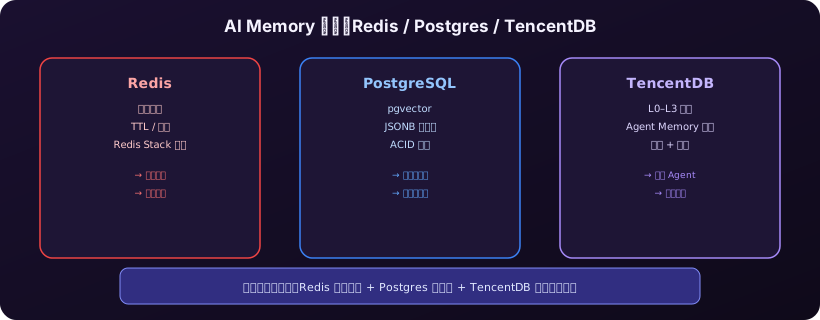
Redis excels at in-memory KV: token budgets, tool queues, locks, Pub/Sub when memory updates. Perfect for hot session memory with TTL.
Redis Vector Sets help semantic caching on small hot sets—but RAM cost scales linearly, persistence is not full ACID, and relational analytics are out of scope.
Verdict: Redis is an excellent hot tier, rarely the only Memory Database for production agents.
PostgreSQL: structured long-term memory
pgvector makes Postgres the default open-source Memory Database: chats, JSONB personas, vectors, and FTS in one place with ACID writes.
Teams already on RDS/Supabase should land long-term memory in PG and cache sessions in Redis. You must model L0–L3 layers yourself. Pair with Kimi K3 Tool Calls Loop: Stop and Debug Guide if tool-call loops threaten stability.
TencentDB: layered memory for agents
TencentDB Agent Memory ships L0–L3 layers, Mermaid short-term offload, local SQLite, and cloud hosting. It saves engineering versus raw schema design and offers OpenClaw plugins. See TencentDB Agent Memory Guide (2026) for setup depth.
Comparison matrix
| Dimension | Redis | PostgreSQL + pgvector | TencentDB Agent Memory |
|---|---|---|---|
| Role | Hot / session | General long-term Memory DB | Agent-layered product |
| Vectors | Small hot sets | Strong ecosystem | sqlite-vec / cloud |
| ACID | Limited | Full | Backend-dependent |
| Best for | Cache, TTL state | Custom schema, existing PG | Fast L0–L3 agents |
Scenario-based picks
Prototype: TencentDB local SQLite or single Postgres container.
Team-built agent: Postgres long-term + Redis session cache.
Long coding agents: offload short-term symbols; never stuff full tool stdout into Redis.
Enterprise: managed TencentDB or RDS with row-level security; Redis non-durable only.
Hybrid stacks in production
Typical flow: Redis session → PG/TencentDB layered recall → prompt → async worker writes atoms to PG. That is how you balance cost and recall quality.
FAQ
Can Redis alone be my Memory Database?
Only for demos. RAM cost and weak relational/audit features hurt long-term agent memory.
Does Postgres replace TencentDB Agent Memory?
Yes if you build layers and recall yourself. TencentDB buys time with bundled L0–L3 and OpenClaw integration.
Is Memory Database the same as RAG?
No. Memory includes session state, personas, mutable facts, and evidence—not just static doc chunks.
What do most teams run?
Redis + Postgres hybrid is the common default; TencentDB when layered agent memory must ship fast.
Summary
- Redis: hot tier for sessions— not the sole Memory Database.
- PostgreSQL: default long-term store with pgvector.
- TencentDB: productized L0–L3 when speed to integrate matters.
- Hybrid beats single-store religion in production.
Map memory layers first, then assign Redis, Postgres, and TencentDB to temperatures that fit—benchmark scores matter less than that mapping.
Run your agent memory stack on an always-on cloud Mac
Redis, Postgres, or TencentDB—all need a always-on Memory Gateway. Kvmkit cloud Mac mini keeps OpenClaw + memory + Xcode running 24/7.