
Last updated August 8, 2026. Technical details verified against the AgentVFS docs, Factory AgentFS, and AIGNE AFS.
You are wiring a coding agent to real repos: read trees, apply diffs, run tests, roll back bad patches. The model sees paths and hunks; execution lives in Docker, remote runners, or an Xcode project on another Mac. The missing layer is an AI Virtual File System that aligns agent file semantics with actual storage.
In 2026 three open-source lines stand out: AgentVFS (Neul Labs—mature vault docs), AgentFS (Factory's vfs—fork/checkpoint and proxy), and AFS (AIGNE-io—multi-agent FUSE). All are virtual file systems, but defaults differ: single-agent sandboxes, multi-tenant proxies, or checkpoint-first workflows.
This guide maps where VFS sits in the agent stack, unifies terminology, compares AgentVFS, AgentFS, and AFS, then gives scenario picks and rollout steps—without pretending a git worktree is a full VFS.
Introduction: why agents need a virtual file system
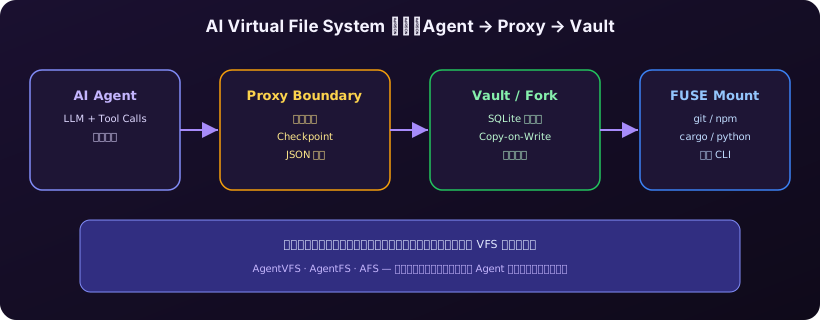
RAG puts knowledge in vector stores; coding agents put it in file trees—source, configs, fixtures, artifacts. Tools read and write paths, yet production has permission walls, concurrent writes, dirty working copies, and "try then revert" loops. Mounting the host raw is risky; pure in-memory fake FS breaks npm, cargo, and xcodebuild. An AI Virtual File System offers namespaces, isolated vaults, branchable forks, time-point checkpoints, outward proxies, and optional FUSE mounts so agents touch normal paths while the base stays auditable.
File state often couples to semantic memory—checkpoint boundaries match tool-session edges. See Redis vs Postgres vs TencentDB: AI Memory Guide for how memory and snapshots split responsibility.
What an AI Virtual File System solves
Without VFS, teams hit recurring pain:
- Weak isolation: agents overwrite
~/.sshor prod configs; - Painful rollback: ten files changed before tests fail—manual git reset;
- Environment drift: laptop paths ≠ CI paths, full of Tool special cases.
VFS abstracts the working copy: experiments run in forks; failed runs drop checkpoints; wins merge to the main vault or export patches. For 24/7 gateway agents, proxy can target a cloud Mac so laptops keep only a thin client—sleep does not erase sandbox state.
Before picking a stack, list read-only vs writable roots, Tool call rates, and whether you need loop detection like PDF to AI Knowledge Base: Book to Skill Guide—file revert and tool loops are the same long-horizon failure modes.
Core concepts: vault, fork, checkpoint, proxy, FUSE
- vault: managed root for a file set—version metadata and policy;
- fork: branch from a vault state; agent edits stay isolated;
- checkpoint: marker inside a fork to save or rewind after N tool steps;
- proxy: forwards remote/sandbox VFS ops to the agent (list/read/write/commit);
- FUSE: kernel mount so shell tools use the virtual tree unchanged.
With these five words, AgentVFS and Factory vfs read faster—they weight the same ideas differently.
AgentVFS (Neul Labs)
AgentVFS is documentation- and vault-centric. Official docs spell vault lifecycle, permissions, and session binding—good for audit-heavy enterprise coding agents: who exported a patch from which checkpoint, when.
Flow: create vault per task → agent edits in a fork → checkpoint after tool rounds → tests pass → commit to main vault or open a PR. Proxy on the gateway; bytes live on cloud Mac or containers; IDE connects to proxy only.
AgentFS (Factory)
Factory AgentFS matches git muscle memory: fork/checkpoint tied to try/revert loops, lighter proxy, easy embed in Factory pipelines. If you already run Factory agents, AgentFS is the shortest integration.
Great for high-churn refactor agents: checkpoint before big edits, rewind on red tests. FUSE varies by OS; Linux CI often mounts the virtual tree for integration tests.
AFS (AIGNE)
AIGNE AFS targets parallel agents on one repo: FUSE namespace, per-agent forks, proxy for locks and merges. Fits multi-sub-agent setups—one writes tests, one edits impl, one runs lint—checkpoint then merge.
AFS stresses namespace federation: multiple vaults under one agent view via proxy—friendly to monorepos and submodule experiments.
Comparison matrix
| Dimension | AgentVFS | AgentFS (Factory) | AFS (AIGNE) |
|---|---|---|---|
| Focus | Vault-centric, documented | Light fork/checkpoint sandbox | Multi-agent FUSE |
| checkpoint | Strong, session audit | Default in try/revert loops | Parallel fork merge |
| proxy | Enterprise gateway story | Thin Factory embed | Multi-vault federation |
| FUSE | Deploy-dependent | Common on Linux CI | Core path |
| Best for | Compliance, cloud Mac 24/7 | Factory users, refactor churn | Parallel sub-agents |
Scenario-based picks
Prototype: single-node AgentFS or AFS FUSE; AgentVFS if vault docs match your governance model.
Enterprise coding agent: AgentVFS + proxy on cloud Mac fleet; sensitive repos never touch laptop disks.
Multi-agent orchestration: AFS parallel forks; gateway isolates sub-agents.
Existing Factory pipeline: AgentFS first—less glue.
24/7 agent dev: VFS proxy co-located with gateway on cloud Mac; vault persists while laptops sleep.
Implementation essentials
- Draw vault boundaries (read-only roots, ignores like
node_modules); - Pick checkpoint grain (per Tool call vs per user task);
- Deploy proxy (TLS, auth, rate limits);
- CI: FUSE or integration test mount → edit → test → rollback;
- Align memory: store checkpoint IDs in session logs—tie to Redis vs Postgres vs TencentDB: AI Memory Guide.
Watch fork count, checkpoint storage, proxy latency, rollback rate. Spikes often pair with PDF to AI Knowledge Base: Book to Skill Guide tool loops—fuse circuit breakers.
FAQ
AI Virtual File System vs git worktree?
Git versions history; VFS adds agent sandbox semantics (vault/fork/checkpoint/proxy), often remote via proxy. Use both: export checkpoint then git commit.
Mix AgentVFS and AgentFS?
Not on the same task path. AgentVFS gateway + AgentFS sandboxes behind proxy boundaries works.
AFS without FUSE?
Some features via proxy API; seamless CLI usually needs FUSE or equivalent mount.
Why cloud Mac for VFS?
Gateway and vault run 24/7; proxy exposes API; laptop sleep does not kill forks—ideal for Apple-platform agent builds.
Summary
- AI Virtual File System = isolation, rollback, and remote execution for coding agents.
- AgentVFS: vault + audit narrative; enterprise and cloud Mac.
- AgentFS: Factory-native fork/checkpoint.
- AFS: parallel agents + FUSE collaboration.
- Align on vault/fork/checkpoint/proxy/FUSE before picking a repo.
No single AI Virtual File System wins every layout—match orchestration depth, compliance, and parallel agents. Pull file ops off raw disk first; then agents become governable.
Run agent workspaces on an always-on cloud Mac
AgentVFS, AgentFS, or AFS—all need long-lived, rollback-ready, auditable execution nodes. Kvmkit cloud Mac mini offers native Unix + FUSE/NFS so vault mounts and OpenClaw Gateway run 24/7.